
The personality pattern map: the ultimate guide for conscious parents
Before your try to fix your child, understand your patterns and how your survival strategy shapes your child’s nervous system with Emotional Trauma Therapist Shaina Rae

In honor of self-love month, I wanted to share what this means for me as a mother. It’s deeper than just “loving yourself” and being kind. It’s loving even the most unlovable parts of yourself that you used to hide or push away. Self-love, to me, is the willingness to turn toward those parts instead of abandoning them. It’s choosing authenticity over performance.
Because secure attachment doesn’t come from perfection. It comes from nervous system safety. When you can hold your own big feelings without shaming or fleeing them, you teach your child that their feelings are safe too. When you can soften toward your triggers instead of reacting to them, you rewrite the pattern. The most loving thing you can do is become the regulated presence you once needed. And it’s forgiving your own parents for their shortcomings, knowing they also did the best they could.
So self-love isn’t just affirmations or bubble baths. It’s the ability to remain connected to yourself under stress. To feel what is coming up and move through it without judging it. Because when you can do that internally, you can do it externally for your child. That’s how secure attachment forms.
Becoming a parent made me have one intention throughout my motherhood, which was to create a secure attachment with my child and raise a confident, kind, and authentic human. Which meant I had to look at my own attachment wounds and upbringing, and work through the shadows and beliefs I was still holding onto.
We all form attachments based on our connection with our parents and the experiences we went through. It shapes everything from how we find partners and give/receive love. To the kind of parents we become, and in turn, the way our children turn out. If we don’t look at our own upbringings and childhood experiences, we usually just end up rinsing and repeat what we know because that’s what our subconscious mind + our nervous system are capable of giving and doing.
But we’re in a generation of cycle breakers and conscious parents who are actually rewiring their beliefs and the way they raise their children. We have the awareness and tools more than ever before to make choices that actually help us to be who we authentically want to be, while raising children to be the same.
When I became a mom, I didn’t realize how attached I would become. Of course, I always thought I would love my child unconditionally, but nothing really prepared me for the level of connection I would feel. I started to read and understand the secure attachment theories and how, from infancy, I was the one who could ensure my daughter grew up with a positive attachment. Which is why I began interviewing women/mothers who had this style of parenting at the forefront of their mission and their own mothering.
I created my podcast for other mothers to feel that they could confidently understand how to raise securely attached children with their presence and their attunement. Not their perfection or their performance. That they could heal their inner child wounds, and regardless of their own attachment styles, could create a healthy bond with their baby. You can listen to one of my favorite interviews about this with Baby Intune here.
Through this work, I reconnected with a friend, Shaina Rae, whom I met online before even becoming moms ourselves. I interviewed her, where she talked about secure attachment parenting to raise authentic children. You can listen here. The thing that stuck out to me the most was how what our child triggers in us is where it was unacceptable for us to react in that way as kids. We judge them, but it’s really ourselves we are judging. Our nervous system is still stuck in a survival pattern. It’s learning to lovingly accept the parts of yourself that felt unlovable, so that you can love and accept those parts of your child.
Through Shaina, I learned about the idea of the 7 Personality Patterns, which comes from Somatic Developmental Psychology. These are developmental survival strategies formed in utero through early childhood, shaped by attachment, regulation, and relational imprinting. They describe how the body organized itself around safety.
The more secure our children feel, the more they have the capacity to feel safe when stressful things happen, and the more they can move through life with resilience.
Secure Attachment + Personality Patterns Q&A
I started understanding my nervous system more and how my own survival patterns were playing out in parenting, and in turn, how my daughter was connecting with me. I interviewed Shaina for a full breakdown of the 7 types and how it shows up in ourselves/our children. Plus, what you can do to support yourself through this.
1. What is the Personality Pattern Map & how do you determine what you are?
We come into the world as babies with the ability to express emotion, but NOT the ability to know how to regulate, process, & metabolize the intensity of our emotional experiences, so we rely on the adults around us to co-regulate our nervous systems so we can learn this skill.
Every emotional/nervous system regulation skill we have (or don’t have) was learned (or missed) in our relationship with our main caregivers.
So when our attachment needs are consistently met (or even “ruptured & repaired”), our nervous system wires for safety, and we have emotional regulation abilities & a beautiful ability to understand & connect with others that allows us to thrive as adults (hello secure attachment!)
But when these needs are not met & these critical life skills are not taught (not because our parents were bad), but because they lived in a generation where no one educated them on the importance of building a securely attached relationship, your body adapts.
The question every child unconsciously asks when their secure attachment needs aren’t being met by a parent is:
“What do I need to do to stay somewhat connected and safe?”
The body answers with a survival strategy.
And that strategy becomes a personality pattern.
The Personality Pattern map shows:
How energy moves (or freezes) in your body
How you relate to others under stress
How you protect yourself from pain
Where your attachment wound lives
And where true attachment healing in your nervous system begins
This is not a diagnosis.
It’s not a personality “type.”
It’s a somatic and relational map of what your nervous system does when you feel overwhelmed, rejected, unseen, or unsafe.
So when you understand your patterns, you finally stop shaming yourself for your natural reactions and can finally start to rewire them!
And when you heal the distortion of each pattern, you don’t just stop the pain, you access more of the beautiful gifts that each pattern has!
This is how we pass down love instead of pain & unconscious trauma to the next generation.
The 7 Personality Patterns (A High-Level Overview)
1. Leaving
“I survive by getting out of here.”
Energy pulls up and out of the body.
These children often experienced overwhelm, intrusion, or emotional intensity that felt too big. The safest option was to leave — mentally, emotionally, sometimes physically.
As adults:
Dissociate under stress
Struggle to stay present in conflict
Sensitivity to people, places, and/or sounds
Call themselves “empaths.”
Need a lot of space
The Distortion: isolation, numbness, avoidance
The Gift: intuition, creativity, spiritual depth, big-picture awareness
The Healing Focus: Through co-regulation with another, healing begins when you learn how to feel safe to be in this world & live in your body so you can build the nervous system capacity to be with whatever emotional experiences arise for you or others in your environment without getting overwhelmed.
2. Merging
“I survive by attaching to someone.”
Energy moves outward toward others.
If the connection felt inconsistent, the child learned:
“I can’t do it myself, so I must wait to be saved. I need others to survive.”
As adults:
People-please
Fear abandonment
Get too lost in their emotions
Lose themselves in relationships
Distortion: enmeshment, anxiety, lack of boundaries
Gift: heartfelt empathy, emotional attunement, relational intelligence (think divine mother energy)
The Healing Focus: Through co-regulation with another, healing begins when you notice & feel that someone sees you, empathizes with you, & understands what you’re going through when it’s hard. And then from that space, being open to them teaching you how you DO have the capacity to build a solid sense of self and do things on your own.
3. Merging Compensated
“I survive by being what you need me to be, and I’ll look independent while doing it.”
This is a more defended version of merging — still with the awareness of other people, but not from an “I need help” energy, but a “I can save you” energy.
The child didn’t like being “needy” or “helpless” when their needs weren’t met, so these systems learn to overcompensate. They become high-functioning, capable, impressive… but attachment-driven underneath (if you need me, then you won’t leave me energy).
As adults:
Hyper-independent
Overachieve for approval
Struggle to receive support
Tie worth to performance
Distortion: over-functioning, burnout, hidden anxiety
Gift: leadership, a desire to serve, discernment, emotional awareness + strength
The Healing Focus: Through co-regulation with another, healing begins when you start to build the nervous system capacity to feel safe to lean on someone when you are struggling, so you can process your suppressed emotions and bounce back fast instead of feeling like you have to hold it all on your own and keep pushing.
4. Aggressive
“I survive by powering over you.”
Energy moves upward and outward onto someone.
In what felt like a “life or death” scenario to the child that the parent was not there for, they start to believe that the world is a threatening place, and they are the only ones who can protect them.
As adults:
Manipulate to get what they want through aggression or charm
Search for competency in people
Struggle with softness and being open with others
Feel safest when they are in control
Distortion: intimidation, anger, dominance
Gift: protection, decisiveness, courage, a leader to the masses
The Healing Focus: Through co-regulation with another, healing begins when you feel someone can hold you in your rage without judging, getting overwhelmed by how you express, or overpowering you, so you can finally begin to soften and feel safe being supported and vulnerable.
5. Enduring
“I survive by holding it all in.”
Energy compresses deeply inward.
These children had a very overpowering parent who didn’t allow them to use their voice, so they learned to hide deep inside their bodies and endure. They learned to tolerate discomfort quietly.
As adults:
Over-tolerate, stay too long in hard situations
Struggle to use their voice
Appear calm but carry deep resentment (AKA: Inwardly resists, outwardly complies)
Feel “stuck” often
Self-sabotage
Distortion: shutdown, emotional suppression, stuck-ness quality
Gift: resilience, loyalty, steadiness, deep trust in the beautiful place of life
The Healing Focus: Through co-regulation with another, healing begins when you notice that someone is agenda-less with you. That someone isn’t trying to make you “do” something, but wants to show you that they care to stay and show you that your needs and voice matter.
6. Rigid Hysteric
“I survive by being chaotic so you can finally see me.”
This pattern holds tension like the rigid type, but the nervous system underneath is more dysregulated. Very chaotic, all over the place energy, deeply desiring to be seen.
As adults:
Swing between control and emotional overwhelm
Care deeply about being seen
Feel like they always need to be “on.”
Experience anxiety beneath high performance
Distortion: nervous system volatility
Gift: charisma, passion, emotional intensity, magnetism
The Healing Focus: Through co-regulation with another, healing begins when you notice that someone can hold you in the chaos without getting overwhelmed, and also see they are connected to you, not because of the chaos, but because they truly see you for “you”.
7. Rigid
“I survive by being ‘right’ and achieving.”
Energy locks and structures.
Often formed when love felt conditional — tied to performance, appearance, or doing things the “right way”.
As adults:
Highly self-disciplined, achieves a lot
Struggle with imperfection
Fear failure
Stuck in the mental field planning, analyzing, & structuring new systems
Struggle to be with the vulnerability of their emotions
Distortion: perfectionism, control, emotional distance
Gift: integrity, excellence, refinement, self-leadership
The Healing Focus: Through co-regulation with another, healing begins when you learn how to feel safe to receive insight and wisdom through your body instead of your mind. I call this learn how “resting in being actually achieves much more than doing”.
2. Does this change with age and different experiences in life, or do you stay the same?
Your dominant patterns will always be the strategies that worked the best for you to maintain attachment in your childhood.
You don’t completely “change types.”
But you can:
Heal distortions of other patterns
Integrate other patterns
Become more flexible
The goal isn’t to erase your pattern. It’s to move from survival to the regulated gift of each pattern.
3. Can you be a mix of all/many or only one?
I always say: you are a pie chart of all 7.
But there will be 1–2 patterns you use more often to cope with emotional overwhelm. That’s your nervous system’s default wiring.
4. How is the child connected to you based on their attachment?
Babies come into the world biologically knowing that they need to attach to you in order to survive.
And because we all have mirror neurons, kids learn what they live.
So children absorb not what we say but what we embody in our day-to-day lives.
For example, if you:
Dissociate, they will too.
Over-function, they track it.
Suppress, they learn that too.
But here’s the beautiful part:
When you heal a developmental “miss” in yourself, you don’t just change your life; you change your kid’s life. Secure attachment is embodied, not taught. What you heal, how you move through your emotions, & how you relate to the world/other people around you becomes their blueprint.
5. What are ways we can support their personality/our own and attachment in general?
#1 Understand what personality patterns you embody & heal the distortions so you can access the beautiful gifts!
#2 Learn how to process your own emotions & triggers via co-regulation with another (AKA: Receive the practice you missed out on in childhood so you can pass on this emotional & nervous system regulation skill to your kids)
#3 Remember it’s not selfish to put your needs first. When you heal, shift, & transform to make your life more beautiful, it creates a natural ripple effect in your child’s life.
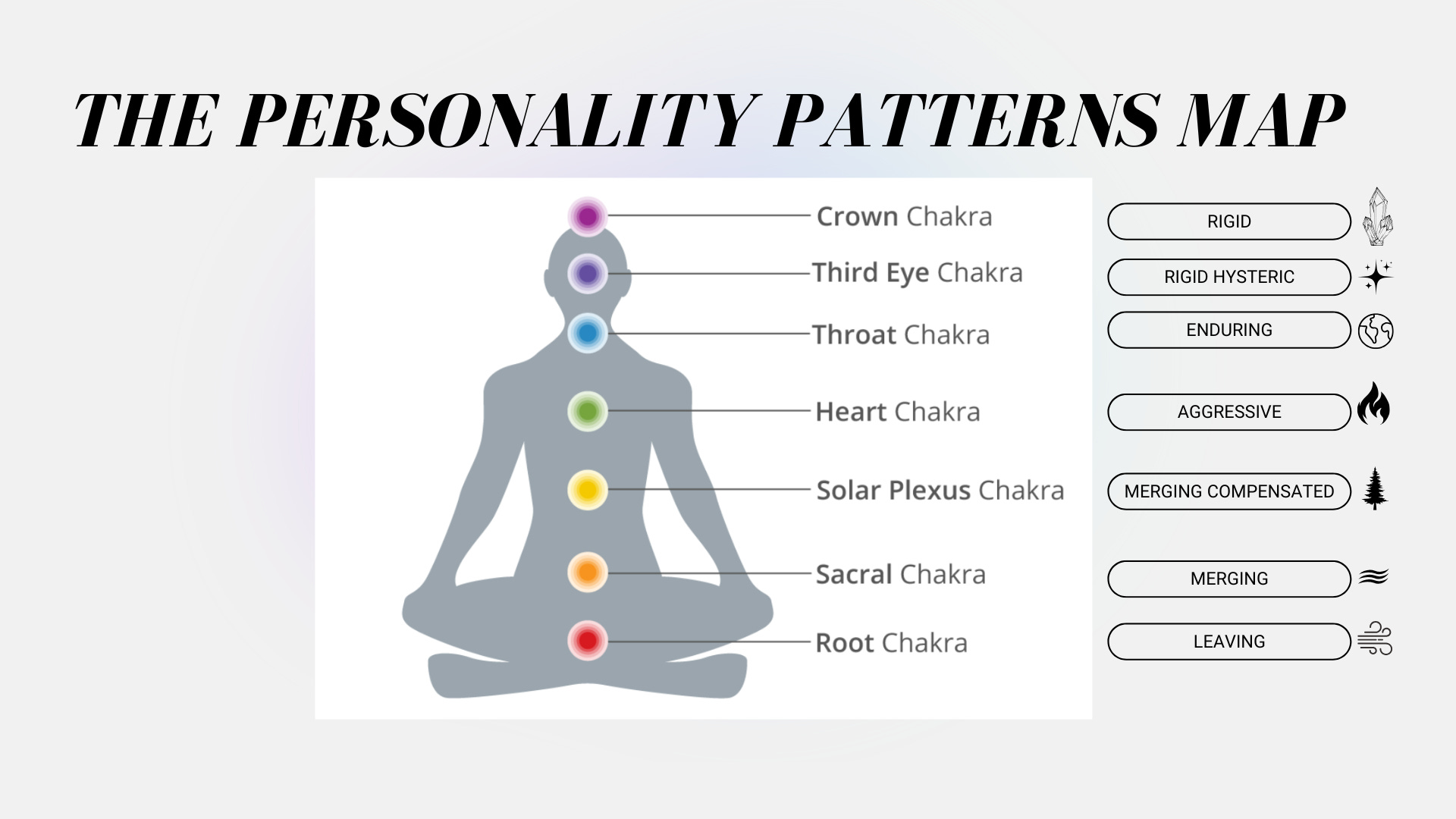
Another fun way to look at the map is the fact that every pattern matches up with the chakra framework.
Leaving → Root (survival)
Merging → Sacral (emotional fluidity)
Merging Compensated → Solar plexus (power)
Aggressive → Heart (fire)
Enduring → Throat (the power to use your voice)
Rigid Hysteric → Third Eye (intuition & spiritual connection)
Rigid → Crown (divine intelligence from the field)
The most important reframe to learning The Personality Pattern Map:
Personality patterns are NOT bad, and they are NOT who you are!
It’s just what you do when you are emotionally overwhelmed; they are adaptive intelligence.
The Personality Patterns Map shows you the strategy your nervous system came up with for you to survive when a critical need was not being met (and that’s amazing!!) You literally wouldn’t be here if your nervous system didn’t do that for you.
And all we are doing (in the work that I teach) is finally becoming lovingly aware of our patterns so we can finally get these needs met and access more of the natural gifts we have that we get to pass down to our kids!
When we work with the Personality Pattern Map, we pass down:
Nervous System Regulation
Secure Attachment
Emotional Literacy
Embodied Safety
That’s the REAL revolution.
If this work interests you, all of my offers provide you with a deep dive into this Personality Patterns Map & the co-regulation you deserve to shift the patterns that have kept you stuck for far too long.
I’d love to support you and show you how empowering healing yourself & breaking emotional, attachment, & generational trauma can be!
Follow along for more @its.shaina.rae & don’t hesitate to DM me & let me know if you read this article! I’d love to hear & answer any questions you have :)
Shaina Offerings
1:1 Mentorship:
The Transformation Accelerator Program:
A 3-month journey to break free from your emotional trauma so you can heal yourself & your future generations
This was very interesting to read. I really think I‘m all 7 of them🙈 But especially right and over-achieving, always stuck in wanting to make a plan instead of just doing
Thank you so much for this!